Reservoir topologies
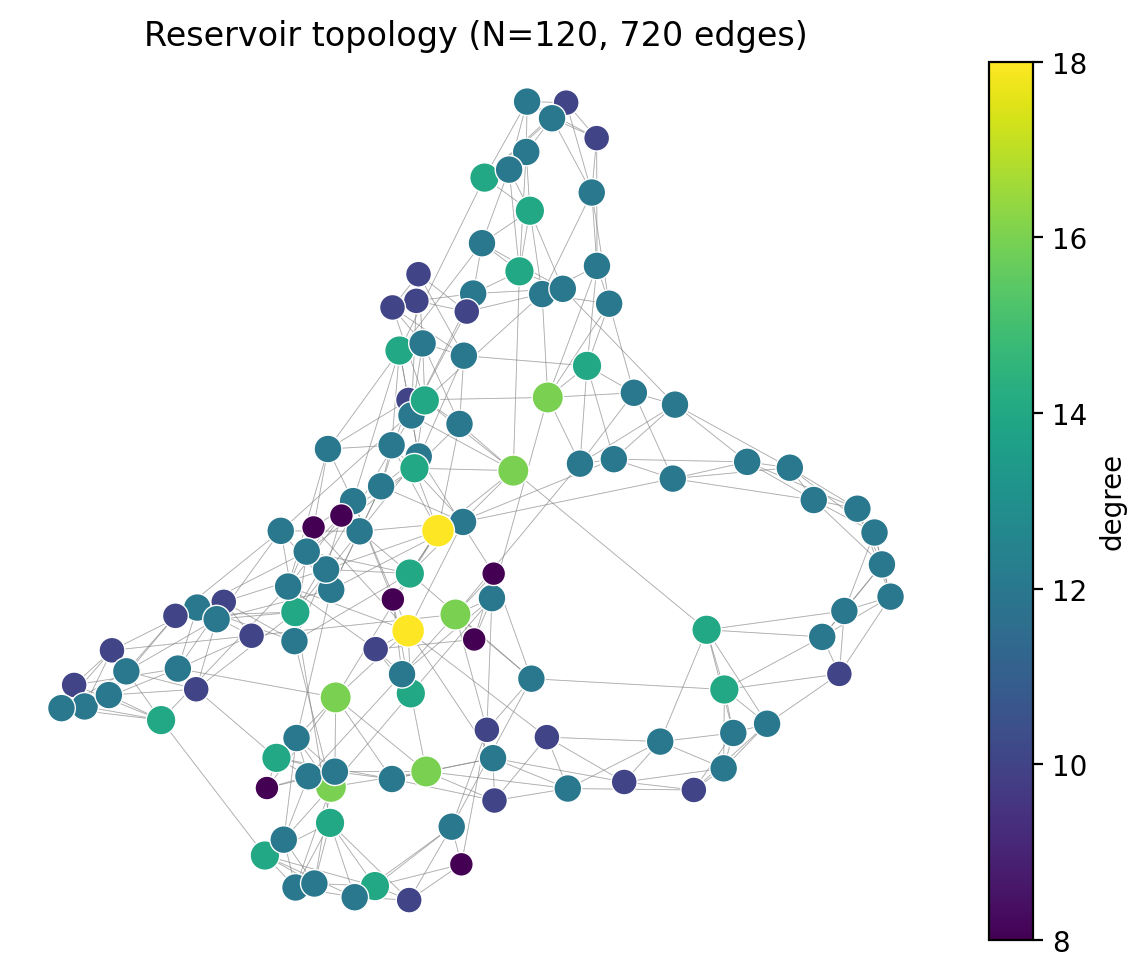
The reservoir's connectivity is a directed graph, and its structure shapes the dynamics. esnfed.topologies provides four models, and graph descriptors to characterise them — the central source of structural heterogeneity in the federated experiments.
from esnfed import topologies

W1 = topologies.random_reservoir(200, density=0.1, rng=0)      # Erdős–Rényi
W2 = topologies.small_world_reservoir(200, k=6, p=0.1, rng=0)  # Watts–Strogatz
W3 = topologies.scale_free_reservoir(200, m=3, rng=0)          # Barabási–Albert
W4 = topologies.ring_reservoir(200, rng=0)                     # simple cycle

# or by name
W = topologies.make_reservoir("small_world", 200, rng=0, k=6, p=0.1)
| Topology | Character |
|---|---|
random (Erdős–Rényi) | each directed edge present with probability density |
small_world (Watts–Strogatz) | ring lattice + random rewiring; high clustering, short paths |
scale_free (Barabási–Albert) | preferential attachment; power-law degree, hubs |
ring | deterministic uni-directional cycle; minimal complexity, competitive |
Graph descriptors
m = topologies.graph_metrics(W2)
# {'n_nodes', 'n_edges', 'density', 'mean_degree', 'clustering', 'avg_path_length'}
Finding from the research
On NARMA-10 the four topologies are statistically close — even the minimal ring is competitive — while on chaotic Mackey-Glass the densely connected Erdős–Rényi reservoir is clearly best. Topology matters in a task-dependent way.
Visualise any reservoir with viz.plot_reservoir.