Echo State Networks
An Echo State Network (ESN) is a recurrent network from the Reservoir Computing paradigm. A large, fixed, randomly connected recurrent layer — the reservoir — projects the input into a high-dimensional dynamical feature space; only a linear readout is trained, by ridge regression.
flowchart LR
  u["input u(t)"] --> Win["W_in<br/>(fixed)"]
  Win --> R["reservoir W<br/>fixed, recurrent<br/>state x(t)"]
  R -->|recurrence| R
  R --> Wout["readout W_out<br/>trained, ridge"]
  u -. "[b; u; x]" .-> Wout
  Wout --> y["output ŷ(t)"]
State update (leaky-integrator neurons):
Readout: \(\hat{\mathbf{y}}(t) = \mathbf{W}_\text{out}\,[b;\mathbf{u}(t);\mathbf{x}(t)]\).
from esnfed import EchoStateNetwork, topologies

W = topologies.random_reservoir(200, density=0.1, rng=0)
esn = EchoStateNetwork(
    n_inputs=1, n_outputs=1, reservoir=W,
    spectral_radius=0.9,   # largest |eigenvalue| of W after rescaling
    leaking_rate=0.5,      # a in (0, 1]; 1.0 = standard ESN
    input_scaling=1.0,
    ridge=1e-6,            # Tikhonov regularisation of the readout
    washout=100,           # initial transient discarded when harvesting
)
esn.fit(u_train, y_train)
y_hat = esn.predict(u_test)
Acceleration (optional)
Three optional, drop-in accelerators speed up the harvest without changing the results — see Performance for benchmarks and when each helps:
EchoStateNetwork(1, 1, W, sparse=True)        # SciPy CSR reservoir (large N)
EchoStateNetwork(1, 1, W, dtype=np.float32)   # half-precision states (large N)
EchoStateNetwork(1, 1, W, use_numba=True)     # force Numba JIT (small/medium N)
With esnfed[fast] installed, Numba is enabled automatically for reservoirs up to N = 1000. All three fall back to pure NumPy when their optional dependency is absent.
The echo state property
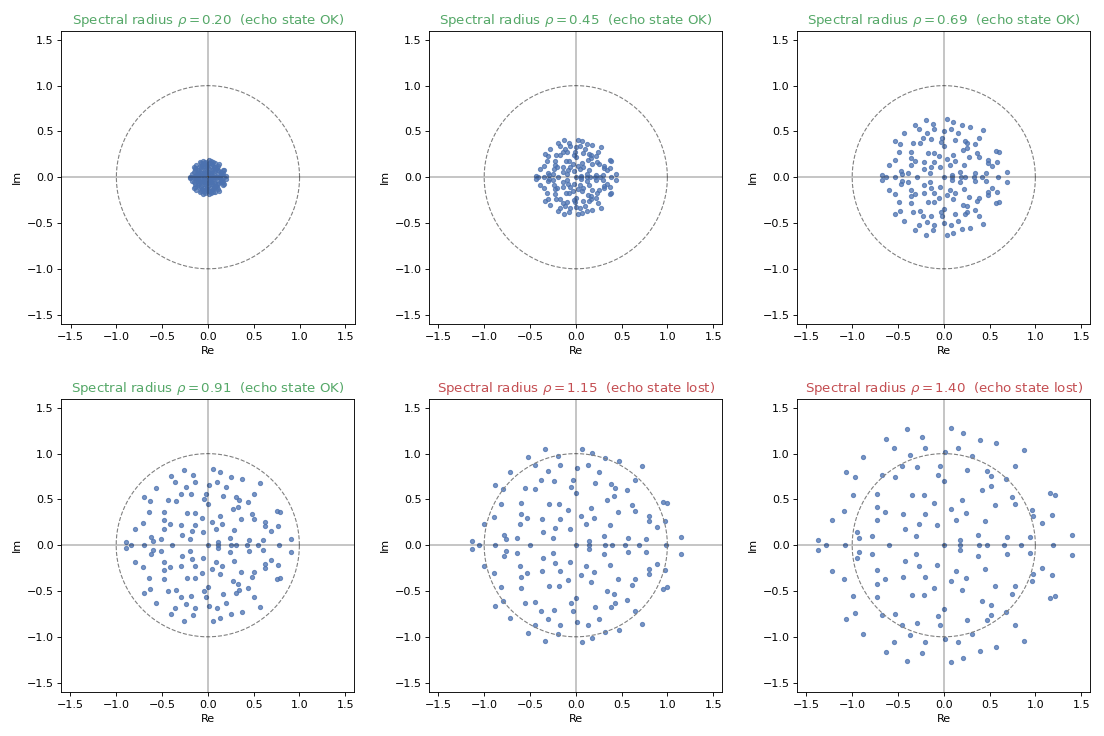
For the reservoir to be useful, its state must depend only on the input history, not on its initial condition. In practice this is encouraged by keeping the spectral radius below 1. As it grows past 1, the eigenvalues leave the unit circle and the property is lost:
Sufficient statistics
Because the readout is a ridge regression, an ESN exposes the two quantities \(\mathbf{A}=\mathbf{Z}^\top\mathbf{Z}\) and \(\mathbf{B}=\mathbf{Z}^\top\mathbf{Y}\) (local_statistics). These are additive across clients, which is exactly what makes exact federated training possible.
See the API reference for every parameter.