Gallery
Interactive, data-backed visualisations of the project. Every chart below is a live Plotly figure (pan, zoom, hover) — the result charts are generated directly from the results database by experiments/build_plotly_gallery.py, and the reservoir visualisations by esnfed.viz.
Want to drive it yourself?
The playground runs a live Echo State Network you can poke, and the results database is queryable in your browser.
Results from the thesis
Echo State Network hyper-parameters
Larger reservoirs and a spectral radius near 1 minimise error on NARMA-10.
Reservoir topology comparison
Topology matters in a task-dependent way (note the log scale).
Federated vs local as the federation grows
Exact federated ridge stays flat; local-only degrades with more, smaller clients.
FedAvg convergence vs exact ridge
Iterative FedAvg converges slowly toward the one-shot closed-form solution.
Prediction ensemble (heterogeneous reservoirs)
The ensemble beats local-only and approaches the centralized model.
Structural alignment
Parameter aggregation only becomes competitive as reservoirs are homogenised.
Federated counterparty-risk forecasting
On real, non-stationary financial data local-only training collapses (log scale).
FedResPrompt vs federated LoRA
Orders-of-magnitude communication and edge-compute savings across model scales.
Acceleration backends
Harvest throughput for the optional Numba / float32 / sparse accelerators.
Benchmark classification accuracy
Federated = centralized; ensemble in between; local-only far behind.
Reservoir heterogeneity extensions
Depth and heterogeneous leaking rates help long-memory Mackey-Glass; multi-type nonlinearities help the faster Lorenz task (see Advanced reservoirs).
Reservoir visualisations
Animations
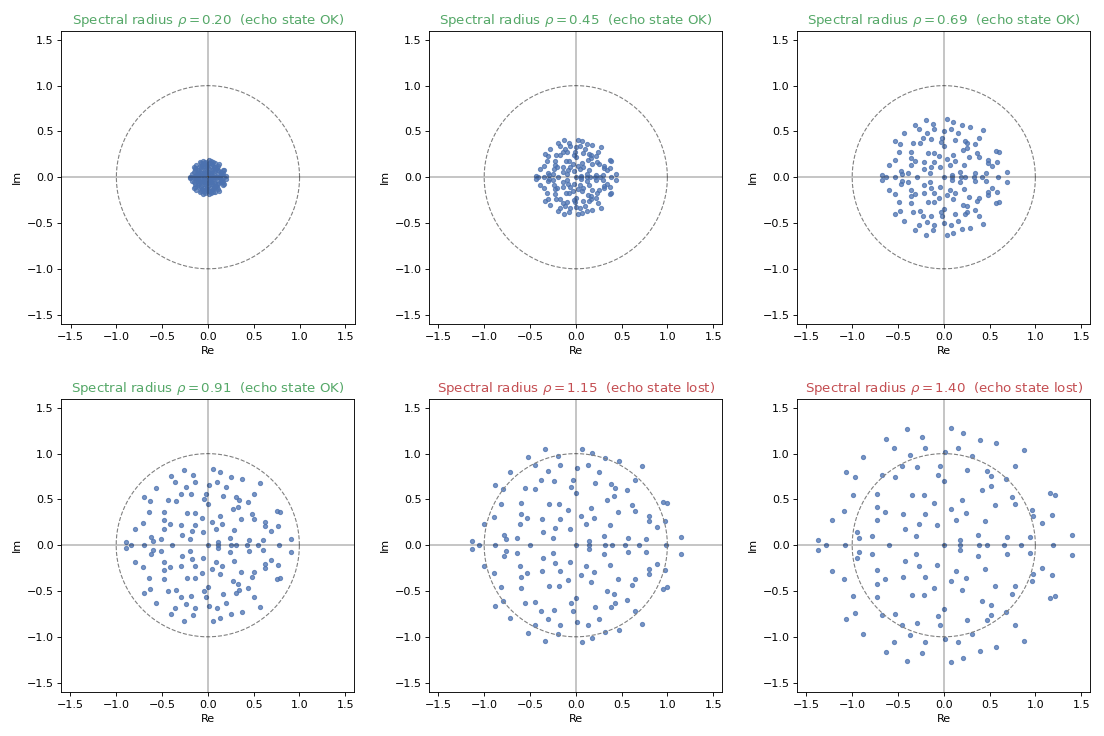
The spectral radius and the echo state property:
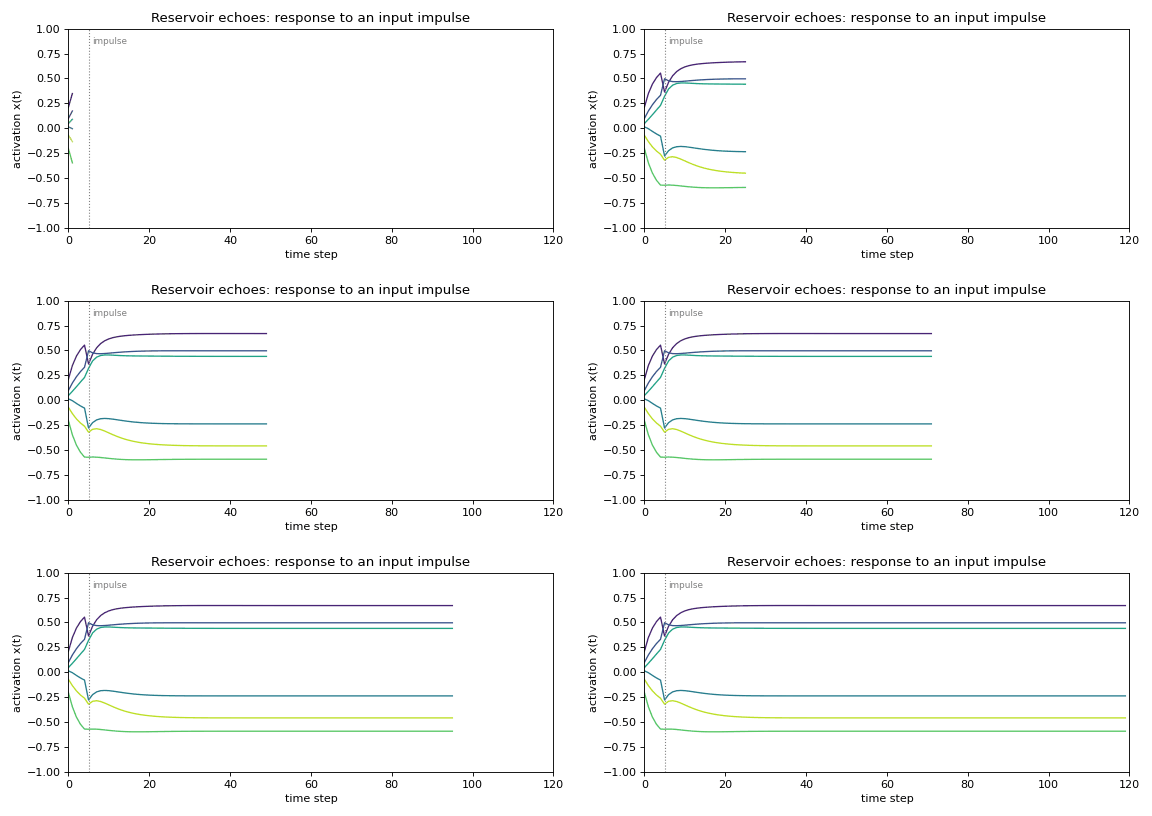
A reservoir's fading response to an input impulse: